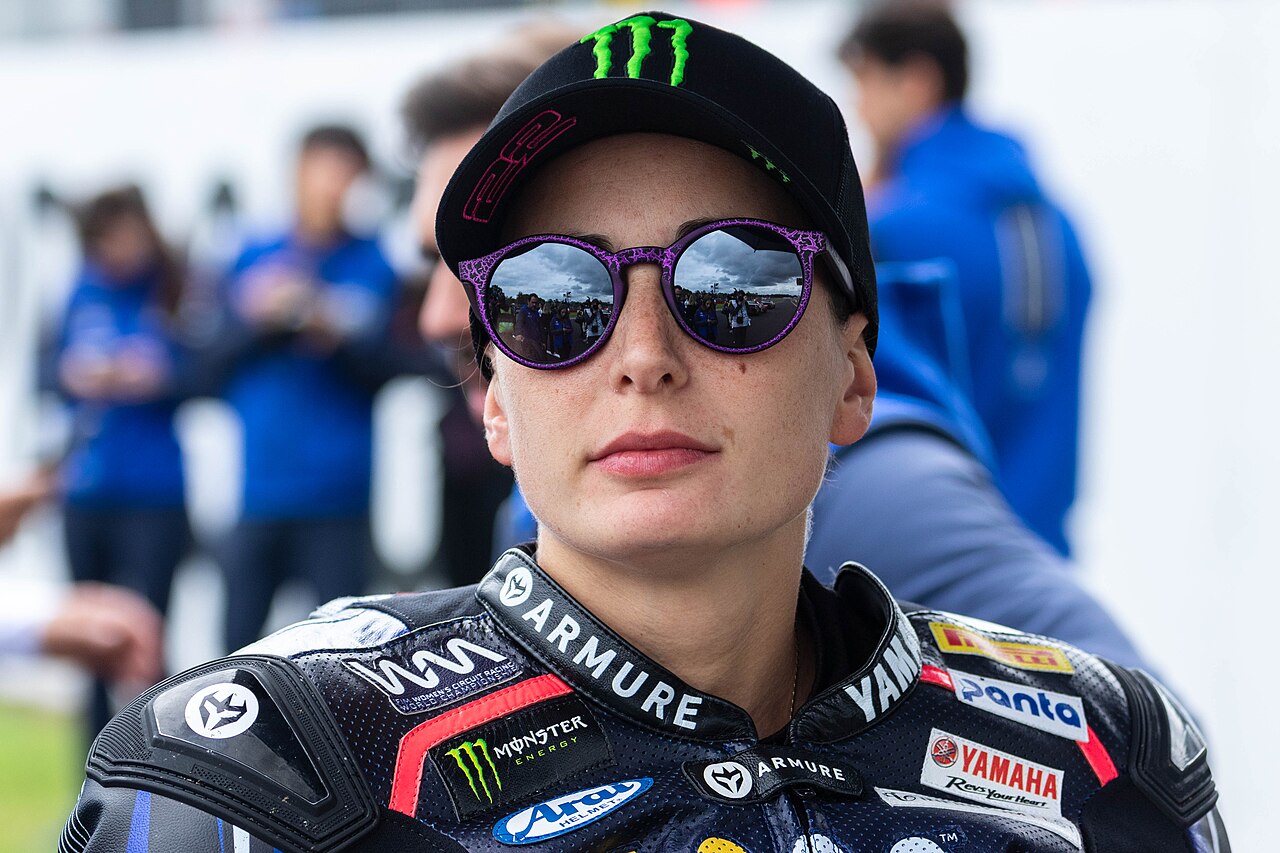
ANA CARRASCO AND THE ART OF Speed
The racer who didn’t just break barriers—she recalibrated the limits of modern motorcycle competition
In the high-stakes world of international motorcycle racing—where factory backing, technical development, and razor-thin margins define success—Ana Carrasco has built something far more durable than results alone.
She has built a legacy of firsts.
From a teenage Grand Prix debut to becoming the first woman in history to win a solo motorcycle road racing world championship, Carrasco’s career is not a straight line. It is a study in precision, setbacks, reinvention—and above all—survival at the highest level of the sport.
ORIGINS: A PRODIGY WITH PURPOSE
THE ART OF Speed Born March 10, 1997, in Cehegín, Spain, Carrasco was introduced to racing almost before she could read. By her early teens, she was already rewriting expectations in Spain’s junior circuits.
Her rise through the national ranks culminated in a breakthrough moment: becoming the first female rider to score points in the Spanish CEV 125cc championship—motorcycle racing’s most competitive feeder system.
That trajectory led her to the global stage in 2013, when she entered the Moto3 World Championship at just 16 years old.
In a category defined by elite youth talent and factory pipelines, Carrasco delivered immediately:
- First woman in over a decade to score Moto3 points
- Career-best 8th place in Valencia
- Consistent finishes in one of racing’s deepest fields
But the early promise came with a familiar motorsport reality: talent alone doesn’t secure longevity. Limited funding and inconsistent machinery disrupted her momentum, forcing a career pivot that would ultimately define her legacy.
THE TURNING POINT: PRECISION OVER POWER
Carrasco’s move to the Supersport 300 World Championship in 2017 marked more than a change in category—it was a strategic reset.
At Portugal’s Algarve International Circuit, she executed one of the most technically precise finishes of the season—timing a final-lap slipstream move to perfection.
The result:
- First woman to win a world championship motorcycle race
One year later, she went further.
2018: A TITLE THAT CHANGED THE SPORT
Carrasco’s championship campaign wasn’t built on domination—it was built on control.
- Multiple podiums
- Pole position at Imola
- Strategic race management across the season
She clinched the title by a single point at Magny-Cours—finishing 13th in a race where calculation mattered more than aggression.
The outcome was historic:
- First female world champion in solo motorcycle road racing (mixed competition)
In an environment where fractions of a second define careers, Carrasco proved something far more significant:
Execution beats expectation.
WHEN MOMENTUM BREAKS: INJURY AND AFTERMATH
In 2020, her trajectory was interrupted by a severe crash during testing. Injuries of this magnitude don’t just impact the body—they alter timing, confidence, and race rhythm.
For many riders, it’s the end of competitiveness.
For Carrasco, it became another phase.
Her return included a victory at Misano in 2021, reinforcing a defining trait of her career: the ability to rebuild under pressure.

Yet the post-injury period also marked a shift. Margins tightened. Consistency became harder to maintain. And the conversation around her performance began to evolve—especially as she re-entered the unforgiving ecosystem of Moto3.
THE MODERN GRID: PERFORMANCE VS. SYSTEM
Carrasco’s return to Moto3 placed her back into one of motorsport’s most ruthless environments—where success is dictated as much by engineering support and funding as raw ability.
Within the paddock and fan circles, opinions diverged:
- Some pointed to the extreme competitiveness of the class
- Others highlighted her lack of top-tier machinery
Both perspectives reveal a deeper truth about modern racing:
The equation is never just the rider.
REINVENTION: DOMINANCE REDEFINED
In 2024, Carrasco didn’t just return—she recalibrated.
Competing in the inaugural FIM Women’s Circuit Racing World Championship, she delivered one of the most statistically complete seasons in recent memory:
- 12 races, 12 podiums
- 4 wins
- Championship secured with 244 points
At Circuito de Jerez, she became the first-ever champion of the series—adding yet another historic milestone to her résumé.
This wasn’t just dominance.
It was total control across an entire season.
STEP UP: THE SUPERSPORT CHALLENGE
ANA CARRASCO AND THE ART OF Speed Carrasco’s next move was deliberate.
In 2025, she advanced to the Supersport World Championship, joining Honda and transitioning to the Honda CBR600RR.
The jump brought new demands:
- Higher-powered machinery
- More experienced competition
- Increased technical complexity
Her rookie season yielded no podiums—but delivered something more valuable:
Adaptation data. Race intelligence. Long-term positioning.
Now competing with Honda France in 2026, Carrasco is firmly in a development phase—refining pace, consistency, and technical feedback in one of the sport’s most demanding categories.
THE NUMBERS VS. THE IMPACT
On paper, Carrasco’s career includes:
- 7 WorldSSP300 wins
- 12 podiums
- Multiple championships across categories
But numbers alone don’t define her influence.
She is:
- The first woman to score in modern Moto3
- The first to win a world championship race
- The first to win a mixed-gender world title
- The first champion of a global women’s circuit series
More importantly, she achieved it while navigating:
- Funding instability
- Equipment disparities
- Career-threatening injury
FINAL LAP: A CAREER STILL IN MOTION
From a race engineer’s lens, Carrasco’s journey illustrates the core truth of motorsport:
Performance is a system—not an individual variable.
Yet what separates her is the ability to remain competitive across changing systems.
She has:
- Won when conditions aligned
- Survived when they didn’t
- Adapted when others faded
In a sport that rarely allows second acts—let alone third—Ana Carrasco is still writing hers.
And that may be her most impressive result yet.
Leave a Reply