Table of Contents
How Sabine Schmitz, driving as Sabine Reck, became the only woman ever to win the Nürburgring 24 Hours outright — twice.
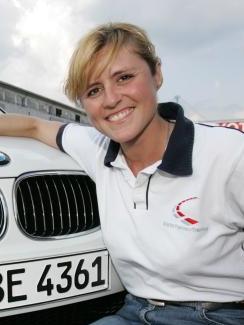
There is a corner on the Nordschleife, not far from the hotel where she grew up, that now carries her name. It is a fitting tribute for a woman who didn’t just drive the Nürburgring — she seemed to live inside it. Over a three-decade career, Sabine Schmitz completed more than 33,000 laps of the 20.8-kilometre “Green Hell,” a feat that helped earn her the nickname Queen of the Nürburgring long before the wider world discovered her on television.
Born near the circuit in 1969, Schmitz grew up in her family’s hotel in Nürburg, where she rubbed shoulders with Formula 1 drivers passing through and caught the racing bug early — reportedly taking the wheel of her mother’s BMW on the Nordschleife at seventeen, before she even had a license. That early obsession with the track would eventually deliver the two victories that defined her legend.
How Sabine Schmitz got Back-to-Back Glory
Racing under her married name, Sabine Reck, Schmitz teamed up in 1996 with Johannes Scheid — a local veteran from nearby Kottenborn — in a BMW M3 E36 prepared by Scheid Motorsport. The car competed in Group N, the production-based category with strict limits on modification: standard engine, homologated suspension, no aerodynamic trickery. Together with Hans Widmann completing the driver lineup, the trio took the car to outright victory in the 1996 Nürburgring 24 Hours.
It was a landmark result. As one retrospective put it, Schmitz became the first woman in history to win a major international 24-hour endurance race not in a class, not in a category, but overall.
A year later, she did it again. For the 1997 edition, Schmitz and Scheid were joined by Hans-Jürgen Tiemann and Peter Zakowski, and the BMW M3 — How Sabine Schmitz since immortalized among fans under the nickname “Eifelblitz,” or Eifel Lightning — crossed the line first once more. To this day, no other woman has matched the feat of winning the race outright.
A Track Written Into Her DNA
How Sabine Schmitz made the wins remarkable wasn’t just the result, but the terrain. The Nürburgring 24 Hours is run on a combined circuit incorporating the full Nordschleife — more than 25 kilometres per lap when linked with the modern Grand Prix layout — How Sabine Schmitz, with cars from wildly different classes sharing the track simultaneously, through day, night, fog and rain. It’s widely regarded as one of the most punishing endurance tests in motorsport.
Few people, if anyone, understood that combination of variables better than Schmitz. She was even a Nürburgring taxi driver, using BMW M5s to shuttle white-knuckled tourists around the track she knew like the back of her hand. That intimacy with every curve, camber and blind crest of the Nordschleife became her signature — and, colleagues and fans alike agreed, gave her an edge no rival could easily replicate.
How Sabine Schmitz went From Racer to Global Icon
The 24 Hours victories launched a racing career that included wins in the Castrol-HAUGG Cup and VLN endurance series, plus the 1998 VLN Endurance Championship title. But it was television that turned Schmitz into a household name far beyond Germany. She rose to fame teaching Top Gear host Jeremy Clarkson to drive the Nürburgring, helping him set a lap time in a Jaguar S-type diesel. She went on to become a full-time Top Gear presenter in 2016, delighting audiences with stunts that ranged from tackling the King of the Hammers off-road race to humbling seasoned Porsche drivers in a hot hatch around her home track.
A Legacy Etched in Asphalt
How Sabine Schmitz died of cancer on 16 March 2021 at the age of 51, following a diagnosis in 2017. Tributes flooded in from across the motorsport and television world. Top Gear executive producer Clare Pizey said Schmitz radiated positivity and was a force of nature for women drivers in the motoring world. Nürburgring track management called her passing a loss of the circuit‘s most famous female racing driver.
Months later, longtime co-driver Johannes Scheid led a commemorative lap of the Nordschleife in the very 1996 “Eifelblitz” BMW M3 the pair had once driven to victory — a rolling salute to the partnership that made history.
Today, a corner of the Nordschleife near her childhood home bears her name: the Sabine-Schmitz-Kurve. It stands as a permanent marker on the track she mastered like no one before or since — proof that more than a quarter-century after those two BMW M3 victories, the Queen of the Nürburgring still owns a piece of the Green Hell.
Sources
- The Drive — Sabine Schmitz Honored With Special Nürburgring Lap Led by Longtime Co-Driver
- BMW Blog — Nürburgring Legend Sabine Schmitz Passed Away Last Night at 51
- Outlook (AUB) — Women in Motorsports: Remembering Sabine Schmitz
- Wikipedia — Sabine Schmitz
- Not Enough Cylinders — Sabine Schmitz: The Queen of the Green Hell
- Deutsche Welle (via PressReader) — Sabine Schmitz, ‘Queen of the Nürburgring,’ dead at 51
- Gulf News — Tributes pour in for Sabine Schmitz — Top Gear’s ‘Queen of the Nürburgring’